
Hoarding Printing Solutions for Effective Outdoor Advertising

Updated: Oct 12
Every construction site has a story to tell. Behind the barriers, something new is taking shape: a block of flats, a new shop, an office or a hotel. For months, sometimes years, thousands of people walk and drive past the site every day. That makes the hoarding around it one of the most valuable advertising spaces in town.
Hoarding board printing is all about making the most of that space. With the right graphics, a plain timber barrier becomes a bold showcase for your project, your brand or your client. At The Sign Company UK, we print and install hoarding graphics for developers, contractors and retailers. In this guide we explain the main types of hoarding, the materials used, how to design graphics that work and what happens during production and installation.
Key Takeaways
Printed hoardings protect a site while turning it into valuable advertising space.
The right materials and inks are essential for graphics that survive outdoor conditions.
Clear, bold designs and careful installation make the biggest difference to the result.
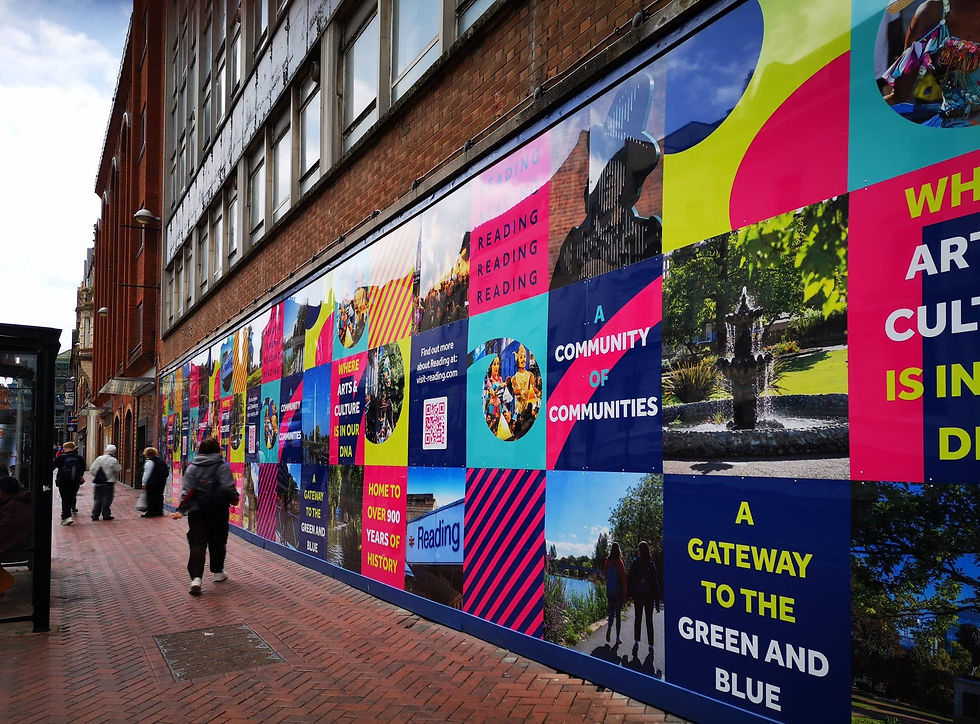
Why Print Your Hoardings?
Plain hoarding boards do the basic job of keeping a site safe and secure, but they do nothing to sell your project. Printed graphics change that. They can build excitement about a new development, generate early enquiries for homes or commercial space, and show neighbours what is coming in place of the noise and disruption.
They also make a site look cared for. Bright, professional graphics help reduce flyposting and graffiti compared with bare timber, and they reflect well on the developer and contractor. For retailers, a printed hoarding during a refit keeps the brand visible and tells customers when to come back.
Hoarding Printing Essentials
Types of Hoardings
Hoardings come in a few main forms, each with a slightly different job.
Construction site hoardings are the solid barriers around building and demolition sites. Their first job is safety and security, but they are also ideal for showing CGIs of the finished development, project information, sales details and contractor branding.
Advertising hoardings are large display boards in high-traffic locations such as main roads, town centres and retail parks. Their only purpose is to promote a product, service or brand, so the graphics need to be big, bright and instantly readable.
Event and retail hoardings are used around temporary venues, store refits and pop-up spaces. A retailer refurbishing a shop might wrap the frontage in printed graphics announcing “Coming Soon”, while events use hoardings for branding, crowd control and wayfinding. These are often designed to be reused.
Materials Used in Hoarding Printing
The material you choose affects how long your graphics last, how they look and what they cost.
Self-adhesive vinyl is printed and applied directly to plywood or composite hoarding boards. It gives a smooth, seamless finish and is one of the most popular options for construction sites.
PVC banners are tough, flexible and weather-resistant. They can be fixed to fences, frames or existing hoarding boards with eyelets and cable ties, which makes them quick to install and replace.
Mesh banners have tiny perforations that let the wind pass through. They are ideal for large areas and exposed sites, such as scaffolding wraps and tall fences, where solid banners could catch the wind.
Rigid panels, such as aluminium composite or foam PVC board, can be printed directly for a crisp, flat finish. They are often used on premium developments, retail hoardings and longer-term projects.
Key Design Considerations
A hoarding is usually seen from a distance or on the move, so the design needs to work quickly.
Keep it simple. One strong image and a short message work far better than lots of small details.
Make text large. Headlines, website addresses and phone numbers should be readable from across the street.
Use strong contrast. Dark text on a light background, or the reverse, makes messages stand out.
Stay on brand. Use your logo, colours and fonts consistently to build recognition.
Think about panel joins. Hoardings are made up of individual boards, so avoid placing faces or key text across the joins.
High-quality artwork is essential. Images need to be high resolution at full size, and designs should be supplied as print-ready files set up to the exact dimensions of the hoarding.

Production and Installation
Printing Techniques
Hoarding graphics are produced on large-format digital printers that can handle vinyl, banner, mesh and rigid boards. The main methods are:
UV printing: inks are cured instantly with UV light, giving bright colours and good resistance to fading. Flatbed UV printers can print directly onto rigid panels.
Solvent and eco-solvent printing: durable, water-resistant inks widely used for outdoor vinyl and banners.
Latex printing: water-based inks that are durable outdoors and give off less odour, which makes them popular for vinyl applied in public areas.
Large hoardings are usually printed in sections or panels that line up when installed. The right ink and material depend on how long the hoarding needs to last and how exposed the site is.
Finishing and Durability
Once printed, most graphics are finished to help them last outdoors:
Lamination adds a clear protective layer that helps resist scratches, scuffs and UV fading. It is especially useful for vinyl graphics on busy streets.
Anti-graffiti laminates make it easier to clean off tags and marks in urban areas.
Hemming and eyelets reinforce the edges of banners so they can be fixed securely without tearing.
Wind slits or mesh reduce wind load on large banners at exposed sites.

Check out our blogs on Hoarding Board Installation and Hoarding Graphics to learn how secure setups and striking visuals work together for maximum site impact.
Installation
Good installation is what makes printed hoarding boards look professional. It usually starts with a site survey to measure the hoarding, check its condition and confirm access, working hours and any traffic or pedestrian management needed.
For vinyl graphics, the surface of the hoarding boards is cleaned and prepared first. Each panel is then applied, lined up carefully and smoothed down to avoid bubbles and creases. Banners are tensioned evenly with ties, bungees or frames so they do not sag or flap in the wind. Rigid printed panels are fixed directly to the structure.
Safety is a priority, particularly on busy pavements or when working at height. Once the job is complete, the hoarding should be checked regularly, and any damaged panel can be replaced individually without reprinting the whole run.
For more detail, read our blogs on Hoarding Board Installation and Hoarding Graphics to see how secure setups and striking visuals work together on site.
Frequently Asked Questions
What are hoarding boards made from?
Construction hoarding boards are most commonly made from exterior-grade plywood fixed to a timber or steel frame. Modular steel and composite systems are also popular, especially on larger or longer-term projects.
What size are hoarding boards?
Many hoardings are built from standard sheet sizes, such as 2440mm x 1220mm, often fixed portrait to create a solid wall. Overall height varies by site and local requirements, so it is worth confirming with your contractor.
How do you keep printed hoardings looking good outdoors?
Use outdoor-grade inks and materials, add a protective laminate and make sure graphics are properly applied and secured. Regular checks help spot damage early.
Do I need permission for a hoarding?
If a hoarding sits on or over a pavement or road, you will usually need a hoarding licence from the local council. Adverts on hoardings may also need advertisement consent, so it is best to check before installation.
Can hoarding materials be reused or recycled?
Yes. Timber and metal hoarding systems can often be reused on other sites, and many printed materials can be recycled through specialist schemes.


I didn’t expect to like clipart fonts as much as I do, but they turned out to be super fun. Instead of just letters, they include little graphic elements that make your projects look unique. I used clipart fonts in a kids’ activity booklet, and they were a hit—they added playfulness without requiring extra illustrations. They’re creative and versatile, and they can make even simple designs look original. If you enjoy experimenting with visual details, clipart fonts are definitely worth exploring.