
Corporate Sign Design for Small Company: A Practical Guide

A small company's sign is often the first real-world contact a customer has with the brand, long before they read a website or walk through the door. Get corporate sign design for small company premises right, and it does quiet, constant work: guiding footfall, signalling professionalism, and reinforcing a brand every single day.
A well-planned mix of exterior, wayfinding and office signage gives a small company the strongest return, provided it's ordered from experienced sign makers who understand local materials and planning rules. That's a different answer to "buy the biggest sign you can afford". Budget matters, but sequencing and specification matter more.
This guide sets out which signs to prioritise first, what to expect from sign makers on cost and materials, and how to keep a small design budget working
hard rather than disappearing on the wrong order.
Which Signs Does a Small Company Need First?
Exterior signage comes first, followed by reception and wayfinding signage, then illuminated or promotional extras once the basics are working. Corporate signage for a small company typically falls into three groups: business signs that help people find the premises, indoor signage that guides visitors once they're inside, and office signage that supports daily operations.
Getting the order right avoids overspending on decorative extras before the essentials are covered. A shop or office that skips clear exterior signs but installs elaborate indoor displays has the priorities backwards.
Shopfront and Exterior Signs That Help Customers Find You
External signage is the first thing most customers see, so it needs to work from a distance and at speed. Fascia signs mounted above a shopfront, showing the company name and logo, remain the most recognisable form of commercial signage on any high street.
For businesses set back from the road, a freestanding totem or monolith sign gives visibility that a fascia sign alone can't provide. Shop front signage should stay legible from sensible distances: 30 to 50 metres for a small A-frame or window sign, further for larger fascia lettering.
Keep exterior signs simple. Company name, logo, and perhaps one line about what the business does is usually enough.
Reception, Door and Wayfinding Signs for Visitors
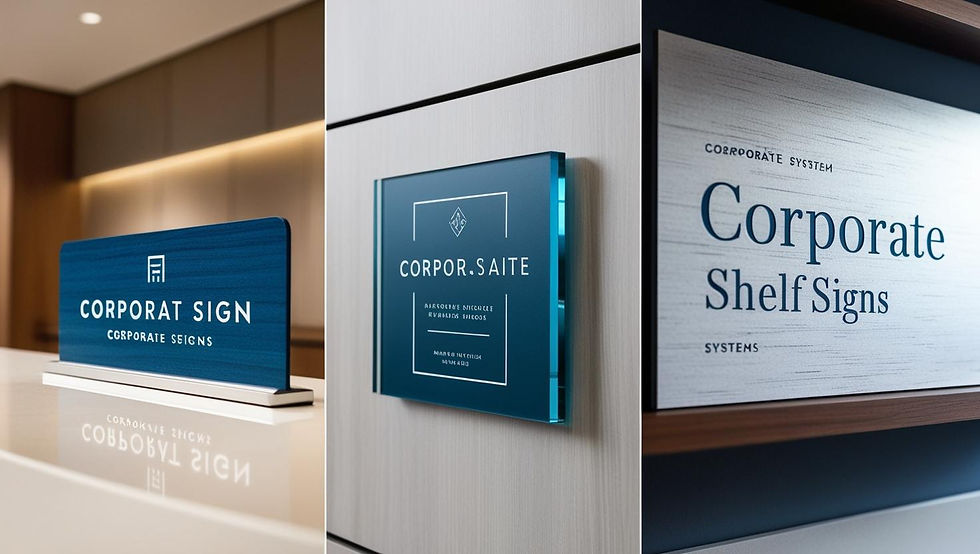
Indoor signage picks up where exterior signs leave off, guiding visitors from the front door to the right desk, room or department. Office signage in a reception area typically includes a branded wall sign or logo panel, since this is often the backdrop for first impressions and photographs.
Door signage should be consistent throughout the building: same font, same colour scheme, same mounting height. Wayfinding signage matters most in larger offices or multi-room premises, where visitors need clear directional cues rather than guesswork.
A simple numbering or colour-coding system on doors reduces confusion without needing elaborate design work.
When Are Illuminated Signs or Flags Worth Considering?
Illuminated signs earn their cost when a business operates after dark or sits on a busy road where visibility competes with other shopfronts. LED-lit fascia signs or halo-lit lettering keep a business visible into the evening, which matters for cafés, restaurants and any premises with extended trading hours.
Flags work well for temporary visibility: launches, markets, or businesses without a fixed shopfront. They're inexpensive relative to permanent external signage and easy to move between locations.
Neither is essential on day one. Many sign makers recommend starting with strong non-illuminated signage and adding lighting once trading patterns show
it's worth the investment.

How Do You Design and Order Signs on a Small Budget?
A modest signage budget stretches furthest when it's spent on one well-made exterior sign first, with materials chosen for the specific location rather than the cheapest available option. Signage design for a small company doesn't need a large agency brief. It needs a clear brand identity applied consistently, sensible material choices, and a sign maker who asks the right questions before quoting.
Make Your Brand Easy to Recognise and Read
Consistency across every sign builds recognition faster than any single striking design. Use the same logo file, the same brand colours, and no more than two fonts across all custom signs, from the shopfront to the smallest door sign.
Readability comes before decoration. High-contrast colour combinations, such as dark text on a light background, work better at a distance than subtle tonal pairings that look elegant up close but disappear from the pavement.
Avoid script or handwritten fonts on anything meant to be read quickly. Save decorative typefaces for secondary details, if at all.
Choose Materials and Finishes for the Location
Material choice should match where the sign will live, not just what looks good in a catalogue. External signs need weather resistance: aluminium composite panels or powder-coated aluminium hold up against rain and UV exposure, typically carrying a 3 to 5 year fade warranty from reputable sign makers.
Indoor signage has more flexibility. Acrylic panels and foamex boards give a clean finish for reception areas and office signs without the added cost of weatherproofing.
Material | Best Use | Typical Lifespan |
Aluminium composite panel | External fascia, totem signs | 5+ years |
Acrylic | Indoor reception, wayfinding | 5+ years indoors |
Foamex | Indoor signage, short-term displays | 2 to 4 years |
Vinyl graphics | Window decals, door signage | 3 to 7 years |
Ask for material samples before committing to a full order. Colour and finish can look different under shop lighting compared to a screen or printed proof.
What Should You Ask Sign Makers Before Ordering?
Ask for an itemised quote, a written lead time, and confirmation of who handles installation before signing off any order. Sign makers vary widely in what's included as standard, so get specifics rather than a single lump-sum price.
Useful questions to put to sign makers:
What material and thickness are you quoting for, and what's the expected lifespan?
Do you provide a physical or digital proof before production starts?
Is installation included, and does that cover electrical connection for illuminated signs?
What's the standard lead time, and does it change during busy periods?
What warranty applies to materials and finish?
The Sign Company and similarly established sign makers will usually offer a site survey before quoting, which catches problems like limited access or unsuitable wall fixings early. Skipping this step is a common source of costly revisions later.
What Affects the Total Cost?
Size, material, illumination and installation complexity drive most of the price difference between a basic sign and a premium one. A small non-illuminated fascia sign in vinyl-on-panel costs considerably less than an illuminated, routed-letter version of the same size.
Lead times also affect cost. Non-illuminated bespoke signs typically take 3 to 10 working days to produce; illuminated or multi-part installations can run 10 to 25 working days once electrical work is involved.
Other cost factors worth flagging early with sign makers:
Planning permission or listed building consent, where applicable
Access equipment such as scaffolding or a cherry picker for high installations
Electrical connection for illuminated signage
Ongoing maintenance, such as reapplying vinyl graphics after a few years
Getting quotes from more than one supplier, including The Sign Company, gives a clearer picture of what's standard versus what's an added extra. Comparing itemised quotes rather than single totals makes it far easier to spot where the money is actually going.

For more signage advice, explore our blogs, “Bespoke Signage Companies London” and “Sign Makers UK”, for practical tips and useful ideas.
Conclusion
Strong corporate sign design for a small company starts outside, not inside. Get the fascia or shopfront sign right first, follow it with clear reception and wayfinding signage, and add illumination or flags once trading patterns justify the extra spend.
Consistent branding across every sign, sensible material choices for each location, and clear conversations with sign makers about cost and timelines keep a modest budget working effectively. Whether the work goes to a local independent workshop or a national name like The Sign Company, an itemised quote and a written lead time protect against the surprises that usually come from vague briefs rather than tight budgets.



Comments